Bottle openers
A bar blade or waiter's friend suits most kitchens and bars. Wall-mounted openers work best fixed to a surface for high-volume use. Keyring openers are for carrying about, and personalised engraved openers make practical, lasting gifts.
- Stainless steel resists rust better than chrome-plated alternatives
- Wall-mounted openers need two screws into a solid fixing point
- Waiter's friends fold flat and often include a small foil knife
- Engraving adds 2-5 working days before a personalised opener ships
Showing all 11 results
-
In stock
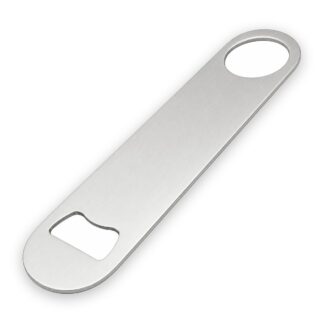
Bar blade bottle opener
£3.95 Add to cart -
In stock

Bottle opener keyring
£2.95 Add to cart -
In stock

Brass counter-mount cork extractor
£34.95 Add to cart -
In stock

Electric wine bottle opener
£24.95 Add to cart -
In stock
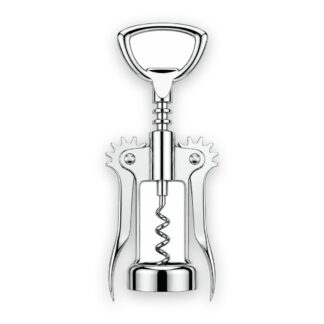
Lever arch corkscrew
£11.50 Add to cart -
In stock

Personalised engraved bottle opener
£9.95 Select options This product has multiple variants. The options may be chosen on the product page -
In stock

Traditional hand bottle opener
£3.25 Add to cart -
In stock
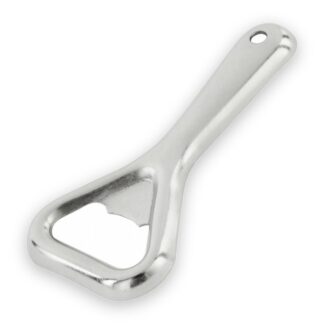
Under counter bottle opener
£8.95 Add to cart -
In stock
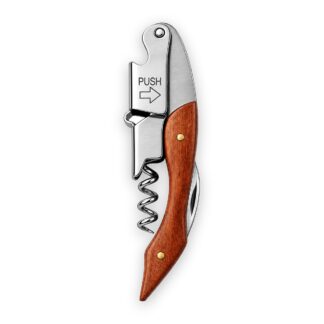
Waiter’s friend corkscrew and bottle opener
£7.95 Add to cart -
In stock

Wall-mounted bottle opener with cap catcher
£16.95 Add to cart -
In stock

Wooden-handled bottle opener
£6.95 Add to cart
Showing all 11 results
A bottle opener ranges from a flat bar blade you keep in a drawer to a wall-mounted fixture that catches caps as they drop. Home kitchens usually want something small and cheap to replace; bars and busy kitchens need something fixed down that survives a Friday night shift. We stock openers in stainless steel, wood and cast metal, plus keyring versions for going out and personalised engraved openers for gifts.
Which type do you need?
Here's how the main types compare, so you can match the opener to where it'll actually be used.
| Type | Best for | Worth knowing |
|---|---|---|
| Bar blade | Kitchen drawers, cafes and anyone who wants a flat, no-fuss opener | Cheap and effective, but small and easy to lose among other utensils |
| Wall-mounted | Home bars, pubs and kitchens where the opener needs to stay put | Needs screwing to a wall or worktop edge, so it's fixed once fitted |
| Winged corkscrew | Anyone who opens wine often and wants a quick, low-effort pull | Built for corks; most only open caps if the base doubles as a lifter |
| Keyring | Bags, keys and anyone who wants a bottle opener on hand away from home | Small grip makes it less comfortable for regular heavy use at home |
How to choose
What's the difference between a bar blade and a waiter's friend?
A bar blade is a single flat piece of metal with a notch at each end, used with a simple lever action against the cap. It's the cheapest, quickest option and has nothing to fold or break. A waiter's friend is a folding tool that combines a bottle opener, a small foil-cutting knife and usually a two-stage corkscrew lever, so it handles both wine and beer. It takes up more pocket space and has moving hinges that can eventually loosen, but it's the standard choice for anyone serving both wine and bottled beer, since one tool covers both jobs. For a home kitchen drawer, a bar blade is usually enough. For table service or hospitality work, a waiter's friend earns its place.
How do you open a bottle without an opener?
The classic method is to hook the cap's edge under a firm, straight edge, such as a kitchen counter, a table lip or a door frame, and push down sharply on the neck so the cap pries off in one motion. A cigarette lighter, a sturdy spoon handle or the edge of another bottle cap can work the same way, using leverage rather than force. Keys or a metal ring can also lever a cap off if you catch the edge properly. These methods put pressure on glass and metal in ways a proper opener is designed to absorb, so there's a real risk of chipped glass, a slipped hand or a cut if the cap doesn't give cleanly. They're fine as a one-off when you're caught out, but a u00a33 bar blade removes the risk entirely and is worth keeping to hand.
Do wall-mounted bottle openers damage the wall?
A wall-mounted opener needs two screw fixings, so it leaves two small holes whether you're fitting it to plasterboard, brick or the underside of a shelf. Beyond that, it doesn't damage the surface in normal use, though the downward pull of opening a bottle does put ongoing strain on the fixing point, which is why a solid wall or a screwed-down worktop edge works better than plasterboard alone. If you're renting or don't want to drill, some cap-catcher styles can be fitted to the underside of a shelf or bar top instead of a vertical wall, and a few sit in a weighted or clamp-on base that needs no fixings at all. For a permanent home bar or a trade kitchen, screwing one to a stud or solid surface is still the sturdiest option.
Common questions
What's the best bottle opener for a home kitchen?
For most home kitchens, a simple stainless steel bar blade is the easiest choice. It's inexpensive, has no moving parts to go wrong, and fits in a drawer. If you also open wine regularly, a waiter's friend covers both jobs in one tool. A wall-mounted opener is worth it if you get through a lot of bottled beer and want somewhere fixed to open them, but it's not necessary for occasional use.
Are wall-mounted bottle openers hard to fit?
No. Most come with pre-drilled holes and fit with two standard wall screws, which takes a few minutes with a drill or screwdriver. The main thing to get right is the fixing point: a stud, solid wall or screwed worktop edge holds far better than plasterboard alone, since the downward pull when opening a bottle puts repeated strain on the screws over time.
Can personalised bottle openers be returned?
Personalised and engraved bottle openers are made to order, so they can only be returned if they arrive faulty or damaged. Because the engraving is specific to your order, we can't resell it to someone else, which is standard for any personalised item. Double-check names, initials and dates carefully at checkout, as we can't amend engraving once it's been sent for production.
What's the difference between a bottle opener and a corkscrew?
A bottle opener levers off a crown cap, the crimped metal lid used on beer and some soft drinks. A corkscrew winds into a cork and pulls it from a wine or spirit bottle, which needs a completely different mechanism. Some tools, like a waiter's friend or a winged corkscrew with a base lifter, combine both functions in one design, but a plain bar blade only ever opens caps.
Do electric bottle openers work on all caps?
Electric bottle openers are built for standard crimped crown caps, the type found on most bottled beer and glass soft drinks, and they handle these quickly and consistently. They're not designed for corked wine bottles or for caps that are unusually thick, bent or already partly damaged, where a manual opener still does a more reliable job. They're best suited to kitchens or bars getting through a lot of bottles in one go.