Mixing glasses
A mixing glass is for stirring spirit-forward drinks like a Negroni or Martini rather than shaking them. Stirring chills and dilutes gently without adding air, keeping the drink clear and silky rather than cloudy.
- Yarai-cut glass gives a secure grip while you stir
- A capacity of 500 to 700ml covers one or two drinks
- A pouring lip makes straining into glasses much easier
- Thicker walls hold cold better during longer stirring
Showing all 6 results
-
In stock

Mixing glass with lid and pouring spout, 600ml
£22.00 Add to cart -
In stock
Mixing glass, bar spoon and julep strainer set
£34.00 Add to cart -
In stock

Stemmed cocktail mixing glass, 550ml
£16.50 Add to cart -
In stock

Tulip cocktail mixing glass, 500ml
£14.00 Add to cart -
In stock
Weighted-base mixing glass, 500ml
£24.50 Add to cart -
In stock
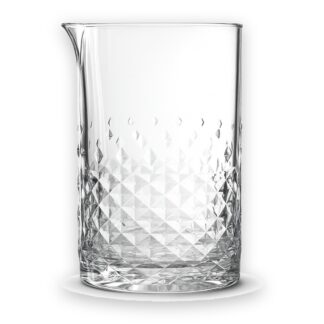
Yarai-cut mixing glass, 750ml
£26.50 Add to cart
Showing all 6 results
A mixing glass is built for stirred drinks u2014 Martinis, Negronis, Old Fashioneds u2014 where the goal is a clear, silky texture rather than the frothy dilution shaking gives you. Most hold enough for two drinks at once, so you can stir a round and strain it out without refilling halfway through. The diamond-cut Yarai pattern isn't just decorative: the facets give your hand grip on glass that gets cold and wet from condensation.
Which type do you need?
Here's what separates the common styles of mixing glass.
| Type | Best for | Worth knowing |
|---|---|---|
| Yarai-cut mixing glass | Anyone who stirs often and wants a secure grip | Costs more than a plain glass for essentially the same job |
| Plain mixing glass | Occasional use, or a first mixing glass on a budget | Gets slippery once condensation forms on the cold surface |
| Mixing glass with pouring spout | Stirring straight into serving glasses without a strainer | The spout adds bulk, so it needs more shelf space |
| Small mixing glass, under 500ml | Making a single stirred drink at a time | Awkward for rounds of two or more, so you refill mid-stir |
How to choose
Why stir some cocktails instead of shaking them?
Stirring is gentler than shaking. It chills and dilutes at roughly the same rate but doesn't introduce air bubbles or ice shards, which is why a stirred Martini or Negroni looks glassy and clear rather than pale and slightly cloudy. As a rule, drinks made only from spirits, liqueurs and bitters u2014 with no juice, egg white or cream u2014 are stirred, because there's nothing that needs the vigorous mixing shaking provides. Anything with citrus juice, dairy or egg white is shaken instead, both to combine the ingredients and to chill them fast enough. A mixing glass, bar spoon and strainer are the only extra kit you need beyond a shaker.
What size mixing glass should you actually buy?
Think about how many drinks you usually make at once. A glass around 500 to 600ml comfortably stirs one generous drink or two smaller ones with the ice still able to move freely u2014 cramped ice doesn't circulate and chills unevenly. Going larger, towards 700 to 900ml, is useful if you regularly make rounds of two or three stirred drinks, but it's overkill and slower to chill for a single Martini on a weeknight. A home mixing glass rarely needs to be smaller than 450ml, since you need room for ice plus liquid without it spilling over the rim as you stir.
Does the diamond-cut pattern actually do anything?
Yes, beyond looking good. The faceted Yarai cut, associated with Japanese bartending, gives your fingers something to grip once the glass is cold and wet with condensation u2014 a plain smooth glass gets genuinely slippery in that state, which matters when you're rotating it while stirring. The cuts also make it easier to judge how full the glass is and to see the ice and liquid while you work. It's not essential u2014 a plain, heavy-bottomed glass stirs a drink just as well in terms of temperature and dilution u2014 but if you stir drinks regularly, the grip difference is noticeable enough that most people end up preferring it.
Common questions
Do I need a mixing glass if I already have a shaker?
Only if you drink stirred cocktails like Martinis, Negronis or Old Fashioneds regularly. A shaker can technically stir a drink by swirling gently, but it's harder to see the ice and liquid, and metal doesn't give the same visual feedback as glass. If stirred drinks are a rare treat you can get by without one. If they're a regular part of what you make, a mixing glass, bar spoon and strainer are the natural next step.
What can I use instead of a proper mixing glass?
Any sturdy glass vessel with enough capacity works in a pinch u2014 a large measuring jug or a wide tumbler will stir a drink perfectly well. What you lose is grip once the glass gets cold and wet, and often a comfortable pouring lip, which makes straining messier. It's a fine way to try stirred cocktails before buying dedicated kit.
How long should you stir a cocktail for?
Roughly 20 to 30 seconds of steady stirring is typical for a Martini or Negroni, though it depends on how much ice you're using. You're aiming for the outside of the glass to feel properly cold and slightly frosted, and the drink to have loosened and diluted a little rather than tasting sharply of neat spirit. Tasting as you go is the most reliable way to judge it.
Why is my mixing glass slippery when I stir?
Condensation forms on the cold glass as you add ice, and on a smooth, unfaceted glass that moisture makes it genuinely hard to grip, especially with cold hands. This is the main reason diamond-cut Yarai-style glasses are popular u2014 the facets give your fingers something to hold onto even when the surface is wet.
What's the difference between a mixing glass and a regular glass?
A mixing glass is usually taller and holds more than a typical drinking glass, giving ice room to move freely as you stir, which chills the drink evenly. Many also have thicker walls, which hold cold better over a longer stir, and a shaped rim or spout that makes pouring out the finished drink tidier.