Boston shakers
A Boston shaker is a two-piece shaker: a 28oz tin paired with an 18oz cheater tin or a mixing glass. It seals by pressure rather than a lid, and needs a separate Hawthorne strainer to pour.
- Two pieces: a 28oz large tin plus an 18oz tin or a mixing glass
- No built-in strainer, so a Hawthorne strainer is needed too
- Seals under pressure and is broken with a tap at the seam
- Weighted bases add balance; vinyl coating adds grip and insulation
Showing all 6 results
-
In stock

Boston shaker glass, 16oz
£8.50 Add to cart -
In stock
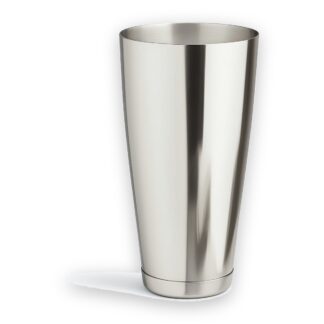
Boston shaker tin, 28oz
£9.50 Add to cart -
In stock

Cheater tin, 18oz
£7.50 Add to cart -
In stock
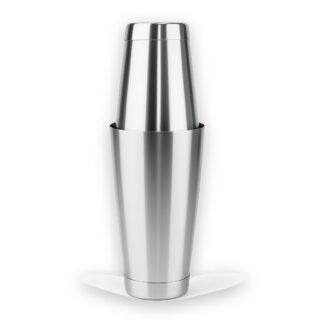
Premium weighted Boston shaker set
£32.00 Add to cart -
In stock

Tin-on-tin Boston shaker set, copper finish
£24.00 Add to cart -
In stock

Vinyl-coated Boston shaker set, black
£19.50 Add to cart
Showing all 6 results
A Boston shaker is the two-piece shaker most bartenders reach for. There is no lid and no built-in strainer, just a large tin and a smaller tin or glass that lock together under pressure when you tap them home. Everything goes in the small half, the large half goes over the top, and the whole thing is shaken as one.nnIt takes a few goes to trust the seal, and it needs a Hawthorne strainer alongside it. In return it holds more, chills faster, comes apart in one tap and washes up in seconds, which is why it has largely replaced the three-piece cobbler shaker behind the bar.
Which type do you need?
Boston shakers differ mainly in what the two halves are made of, and in the finish on the outside of the tins.
| Type | Best for | Worth knowing |
|---|---|---|
| Tin-on-tin | Everyday shaking, and anyone who wants the fastest chill | A 28oz tin with an 18oz cheater tin; metal chills quicker than glass |
| Tin-on-glass | Watching the drink build, and serving in front of guests | The glass half is heavier, breakable and slower to take on the cold |
| Weighted base tins | A steadier shake and a more predictable seal | Extra metal in the base adds heft, so the set is less easy to carry in bulk |
| Vinyl-coated tins | Grip on wet hands, and colour-coding a home bar | The coating insulates against the cold but is not for dishwashers |
How to choose
Tin-on-tin or tin-on-glass?
Tin-on-tin pairs a 28oz tin with an 18oz cheater tin. Both halves are light, both chill quickly, neither breaks when dropped, and the seal is forgiving because metal flexes slightly against metal. Tin-on-glass swaps the small tin for a heavy mixing glass, which lets you see the drink and looks the part at a table. The trade-off is weight, a slower chill because glass carries heat, and the risk of a chip or a crack if the tin goes on too hard. Most home bars are better served by tin-on-tin, with a mixing glass kept separately for stirred drinks.
How to seal and break a Boston shaker
Build the drink in the small tin, add ice, then set the large tin over it at a slight angle rather than straight down. Tap the base of the large tin firmly once with the heel of your hand and the two lock together. Shake with the large tin underneath, holding both halves. To break the seal, hold the shaker so the seam is facing you, find the point where the gap between the tins is widest, and strike that spot on the side of the large tin with the heel of your hand. The halves separate cleanly.
Why bartenders prefer it to a cobbler shaker
A cobbler shaker has three parts with a built-in strainer and a cap, which sounds convenient until the lid freezes shut mid-service or the strainer holes clog with mint and citrus pulp. A Boston has more internal volume for the same footprint, so ice moves further and chills the drink faster, and it comes apart in one tap however cold it gets. It also washes in seconds with nothing to unscrew. The cost is a small learning curve on the seal and the need for a Hawthorne strainer, since a Boston has no strainer of its own.
Common questions
What is a Boston shaker?
It is a two-piece cocktail shaker with no lid: a large tin, usually 28oz, and a smaller 18oz tin or a mixing glass. The two halves are tapped together to form a pressure seal, shaken as one unit, then knocked apart. Because there is no built-in strainer, you pour through a separate Hawthorne strainer.
What size Boston shaker should I buy?
The standard pairing is a 28oz large tin with an 18oz small tin, often called a cheater tin. That combination holds two drinks and enough ice to chill them properly. Smaller sets exist but leave little room for ice to move, and a shaker packed too full chills and dilutes less evenly than one with space.
Do I need a strainer with a Boston shaker?
Yes. A Boston shaker has no strainer built in, so you need a Hawthorne strainer, the flat one with a coiled spring, to hold back the ice as you pour. For drinks with mint, berries or citrus pulp, pour through a fine mesh strainer as well so nothing gritty reaches the glass.
Why is my Boston shaker stuck?
A very cold, very tight seal is normal, and the fix is technique rather than force. Hold the shaker with the seam facing you and look for the widest gap between the two tins. Strike the large tin at that exact point with the heel of your hand. Twisting or prising at the rim tends to dent the tin instead.
What does a weighted Boston shaker tin do?
A weighted tin carries extra metal in the base, which lowers the centre of gravity and gives the shaker a steadier, more controlled feel in the hand. The added mass also helps the seal seat firmly with a single tap. The trade-off is weight, which matters more across a busy bar shift than it does at home.